
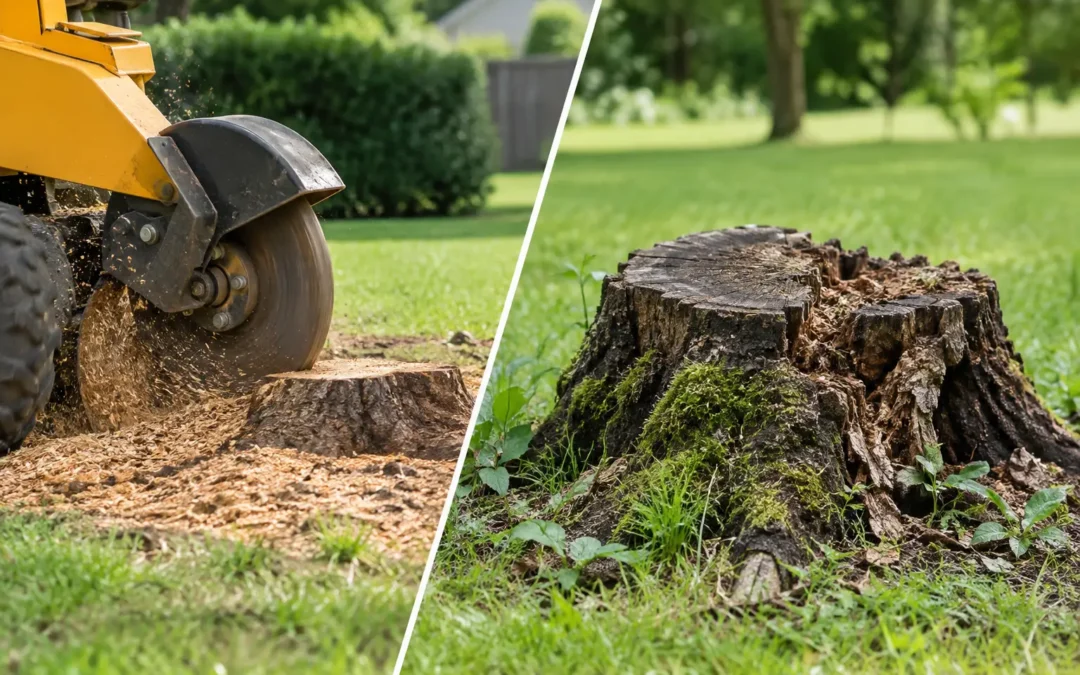
A freshly cut tree can make a yard look cleaner right away, but the stump left behind often becomes the next problem. When weighing stump removal versus natural decay, the real question is not whether a stump will eventually disappear. It will. The question is whether your property can afford to wait years for that to happen.
For a homeowner, acreage owner, or property manager, a retained stump can interfere with mowing, create a trip hazard, attract insects, and limit what can be done with the space. Natural decay has a place in the right setting, but it is rarely the practical choice for an active lawn, landscaped yard, rental property, or commercial site.
What Natural Stump Decay Actually Looks Like
A stump does not break down on a predictable schedule. Its timeline depends on tree species, stump size, moisture, soil conditions, exposure to fungi, and whether the roots remain healthy enough to send up new growth. In a dry or cold climate, a large stump can remain solid for many years.
Softwood species may decay sooner than dense hardwoods, but even a rotting stump does not simply turn into level ground. The wood usually becomes soft in stages. It can develop cracks, fungus, insect activity, and hidden voids while the root system remains underground. The surface may look harmless one season and become an unstable hole the next.
Some property owners choose to speed up decay by drilling holes, adding high-nitrogen material, or applying a commercial stump-decay product. These methods can encourage fungal activity, but they do not offer a quick or guaranteed result. They also leave the stump, roots, and above-ground obstacle in place while the process works slowly.
Natural decay can make sense in a remote wooded area where the stump is well away from paths, mowing routes, buildings, fences, and planned landscaping. In that setting, decaying wood can provide habitat and return organic material to the soil. It is a different decision when the stump sits in the middle of a maintained property.
Stump Removal Versus Natural Decay for Safety
The most immediate difference between stump removal versus natural decay is control. Natural decay leaves an obstacle on the property for an unknown length of time. Professional grinding deals with the visible stump now and reduces the remaining material below the surface.
A stump is easy to see when it is freshly cut and surrounded by bare ground. It becomes easier to miss once grass grows around it, leaves collect over it, or snow covers it. That is when a stump can become a trip hazard for children, visitors, tenants, staff, and maintenance crews.
Mowing around a stump is another common frustration. Repeatedly trimming around it wastes time, while a hidden root flare can damage mower blades or other grounds equipment. On commercial properties, one retained stump can complicate routine maintenance across an entire lawn area.
There is also the issue of decay-related instability. As the wood breaks down naturally, the ground around an old stump can settle. If roots decay beneath a lawn or walkway, shallow depressions may develop where the root system once supported soil. Grinding does not remove every root from the property, but it eliminates the stump and root plate as the main above-ground obstruction and prepares the area for a more manageable finish.
Pests, Fungi, and Unwanted Regrowth
Decay is a natural process, but it is not always tidy. Rotting stumps can become shelter for ants, beetles, and other insects. Not every insect in a stump is a threat to a house or landscape, yet a decaying stump close to buildings is an unnecessary place for activity to build.
Fungal growth is another concern. Mushrooms around a stump often indicate that the wood is decomposing, but they also signal that the process is underway beneath the surface. For property owners who want a clean lawn or garden bed, the look and maintenance of an actively rotting stump can become a nuisance.
Some tree species also produce suckers from their roots after the trunk is cut. These shoots can appear around the former tree location and may continue until the root system exhausts its stored energy. Waiting for natural decay does not necessarily prevent this regrowth. In fact, a stump that remains connected to an active root system may keep producing shoots for a period of time.
Grinding removes the stump itself and disrupts the root plate at the work area. If suckering is a concern, it is worth discussing the tree species and site conditions before work begins so the next steps are clear.
Why Grinding Is Usually the Practical Option
Professional stump grinding is designed for property owners who want the area usable again without the disruption of full excavation. Rather than pulling out a stump and every major root, a grinder uses a rotating cutting wheel with carbide-tipped teeth to break down the wood into chips.
At Stump Chomper, the goal is to grind stumps and root plates to at least 10 inches below ground level where site conditions allow. That depth gives the area room for topsoil, seed, sod, mulch, or many landscaping plans. The stump becomes reusable woodchip material rather than a permanent obstacle.
Full removal by excavation can be appropriate for construction sites, foundation work, utility installation, or projects that require roots to be physically removed. It can also be more disruptive. Digging out a stump may disturb a larger section of lawn, damage nearby irrigation or landscaping, and leave a sizeable hole to repair.
Grinding is often the better balance for residential yards and maintained commercial grounds because it addresses the visible problem efficiently. The equipment is purpose-built for the work, and an experienced operator can work around nearby fences, gardens, and established landscape features with care.
The Cost of Waiting Is Not Always Obvious
Natural decay seems less expensive because there is no immediate service cost. But the lowest upfront cost is not always the lowest overall cost. Consider the added time spent mowing around the stump, repairing damaged mower blades, managing suckers, or working around the space during a landscaping project.
A stump can also delay a project that would improve the property right away. Perhaps the space is needed for a garden bed, a patio extension, a shed, a fence line, fresh sod, or a safer play area. For landlords and commercial managers, an unattractive or hazardous stump can also affect how the property is maintained and presented.
The right choice depends on the stump’s location and your timeline. Leaving a stump to decay may be reasonable at the edge of a large, unused acreage. If it is near a driveway, sidewalk, lawn, building, or future project area, grinding is usually the more direct and property-conscious solution.
What Happens After a Stump Is Ground
A professional grinding job should leave the site ready for the next step, not create another cleanup project. Grinding produces a mix of woodchips and soil. Those chips can be used as mulch in suitable areas, removed, or managed based on the customer’s landscaping plans.
If the goal is lawn restoration, the ground can be leveled with clean soil and reseeded or sodded. Because woodchips use nitrogen as they decompose, it is generally best not to mix a heavy amount directly into the planting zone for new grass or garden plants. Keeping excess chips as surface mulch is often a better use.
Replanting a new tree in the exact same spot may not be ideal, especially if substantial roots remain below ground. A qualified landscaping professional can help select a nearby planting location with enough room for the new tree’s roots to establish. For turf, garden beds, and many hardscaping plans, a properly ground stump creates a far more workable starting point.
Choose the Option That Fits the Property
Natural decay is not wrong. It is simply slow, unpredictable, and best suited to locations where the stump will not affect safety, maintenance, or future use. For most maintained yards and commercial grounds, waiting can turn one small leftover from tree removal into years of inconvenience.
Professional stump grinding gives you a clear finish line: the stump is reduced below grade, the work area is cleaned up, and the space can move forward. A free, honest, no-obligation estimate can help you decide whether removing that stump now will make the next season of property care easier.