
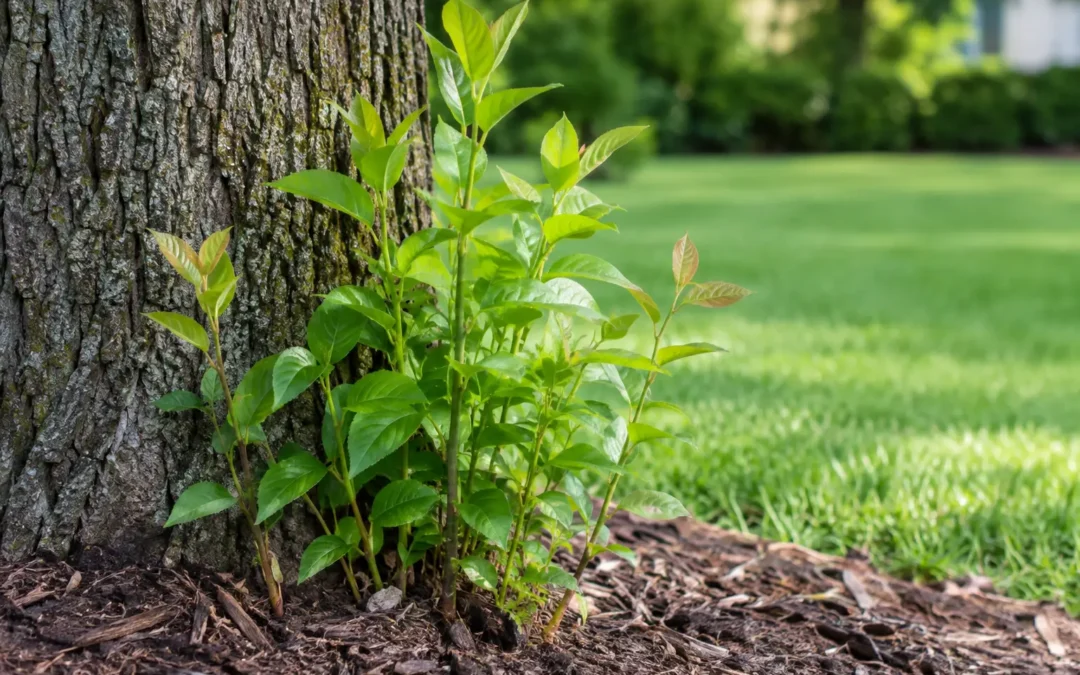
A cut tree can look like a finished job until green shoots start pushing through the lawn, mulch bed, or edge of a driveway. These shoots, commonly called tree suckers, are a sign that the root system is still alive and trying to grow. They may seem minor at first, but repeated suckering can make a yard harder to mow, reduce curb appeal, and delay the landscaping plans you had after tree removal.
For property owners, the solution depends on what is feeding the new growth. A few shoots on a living tree may be manageable with pruning. Persistent shoots growing from an old stump or roots usually call for a more permanent approach: removing the stump and enough of its root plate to stop the cycle.
What are tree suckers?
Tree suckers are fast-growing shoots that emerge from a tree’s roots, trunk base, or remaining stump. They are the tree’s survival response. When a tree is stressed, damaged, heavily pruned, or cut down, stored energy in the roots can trigger dormant buds to grow.
Suckers are different from ordinary new branches. They often grow straight up, appear in clusters, and have a softer, more vigorous look than established growth. After a tree has been removed, they may appear several feet away from the original stump because roots can extend well beyond the trunk’s former canopy.
Some species are especially determined to regrow. Poplar, aspen, willow, lilac, elm, and certain fruit trees are well known for producing shoots from roots or stumps. The exact pattern varies by species, tree health, soil conditions, and how recently the tree was cut.
Why suckers show up after tree removal
Cutting a tree to ground level removes the visible trunk, but it does not automatically kill the living roots below it. Those roots still contain carbohydrates and moisture. As long as that stored energy remains available, the stump and root system may keep sending up shoots.
Mowing the shoots can keep the yard looking tidier for a while, but it rarely solves the underlying problem. Each new shoot can continue gathering energy for the root system. On some properties, suckers return several times in one growing season, especially when the stump was left high enough to produce new growth directly from its edges.
This is also why a tree stump is more than an appearance issue. It can occupy useful space, interfere with new planting, create a trip hazard, attract insects, and leave a property owner dealing with recurring shoots long after the tree crew has left.
When you can simply prune the shoots
Not every sucker means stump grinding is necessary. If shoots are growing at the base of a healthy, living tree, careful pruning may be the appropriate first step. Remove them close to their point of origin using clean, sharp hand pruners or loppers. Avoid tearing the bark or cutting deeply into the main trunk.
It also helps to look at the reason the tree is producing suckers. Compacted soil, lawn equipment damage, drought, root disturbance, and aggressive pruning can all stress a tree. Correcting the stress may reduce future growth, although some species will always be prone to suckering.
For a mature tree that is valuable to the property, an arborist can assess whether the sucker growth points to a larger health issue. Removing visible shoots is straightforward. Diagnosing a declining tree is a separate job and should not be guessed at.
When tree suckers point to a stump problem
Suckers coming from a removed tree are a different situation. If the stump remains, the root system has an energy source and a place to keep producing shoots. Cutting them off repeatedly is ongoing maintenance, not removal.
This is where professional stump grinding makes practical sense. A specialized grinder uses carbide-tipped teeth to break down the stump and major root plate below grade. At Stump Chomper, stumps are ground to at least 10 inches below ground level, helping remove the material that supports continued regrowth while creating a site that can be restored for lawn, mulch, landscaping, or construction.
Grinding does not mean every fine root across the yard is physically extracted. That type of excavation can cause far more disruption to turf, nearby plants, and buried services. Instead, the goal is to remove the central stump and principal root material so it no longer creates a surface obstacle or acts as a strong source of new shoots. Remaining small roots naturally break down over time.
Why leaving a stump can cost more later
A stump may feel easy to ignore after a tree comes down, particularly if it sits near a fence line or behind a shed. But the longer it remains, the more it can complicate routine property care. Lawn mowers and trimmers have to work around it. Hidden roots and suckers can create uneven areas. Decaying wood can also become a place for insects and fungal activity.
On commercial grounds and rental properties, those concerns are not just cosmetic. A stump in a walkable area can become a liability issue, and recurring growth adds labor for maintenance crews. On acreages, old stumps can interfere with access, fencing, grading, and future improvements.
There is a trade-off to consider. If a stump is far from activity areas and the land will remain natural, leaving it may be acceptable. If you want usable, level ground and less ongoing maintenance, grinding is usually the cleaner long-term choice.
Can you kill tree suckers with chemicals?
Herbicide treatment is sometimes used to prevent regrowth from certain stumps, but it requires care. The wrong product, timing, or application can damage nearby shrubs, lawn, gardens, and trees that share a root zone. This risk can be higher with suckering species, where roots may spread a considerable distance from the original trunk.
Chemical treatment also does not remove the physical stump. Even if regrowth stops, the remaining wood can still be a tripping point, a mower hazard, and an obstacle to planting or building. For many homeowners and property managers, grinding addresses both problems at once: the source of suckers and the unusable stump itself.
Avoid drilling into stumps, pouring in household chemicals, or burning them. These methods can be ineffective, create safety problems, and leave a damaged patch of ground without solving the root issue.
What to expect after stump grinding
A professional grinding job leaves behind a below-grade cavity and a mixture of soil and woodchips. Those woodchips can be useful as mulch in appropriate areas, or they can be removed if you are preparing the site for sod, seed, or a hardscape project. The best choice depends on your plans for that section of the property.
For lawn restoration, the area is usually backfilled with suitable soil, leveled, and seeded or sodded. Because woodchips use nitrogen as they decompose, it is best not to mix a large amount into the planting soil for grass or new ornamentals. Keep excess chips as surface mulch, use them elsewhere, or have them hauled away.
If you plan to plant another tree in the same general location, give it room. Planting directly in the old grindings can lead to settling and poor soil conditions. Shift the new tree several feet away when possible, use good-quality soil, and choose a species suited to the site.
A safer, cleaner way to regain the space
Tree suckers are often the visible reminder that a tree removal was only partly finished. You can keep cutting shoots back, but persistent regrowth from a stump usually means the root system needs more than surface trimming.
Before scheduling grinding, mark or disclose any known irrigation lines, low-voltage lighting, drainage, fencing, and underground utilities near the stump. A qualified crew can assess access, stump size, nearby structures, and cleanup needs before work begins. Clear expectations matter, especially when the end goal is a smooth lawn, a garden bed, or a construction-ready area.
A stump-free yard gives you one less obstacle to mow around and one less place for unwanted growth to return. When the ground is properly prepared, the space can finally become part of your property again.